There is a book that nobody can read. Not a rare book. Not a difficult book. A book that no living person — and no dead one we know of — has ever read a single word of. It is about 600 years old, it sits in a vault at Yale, and it is packed with confident, fluent handwriting in a language that appears nowhere else on Earth. We have had it for over a century. We have gotten precisely nowhere.
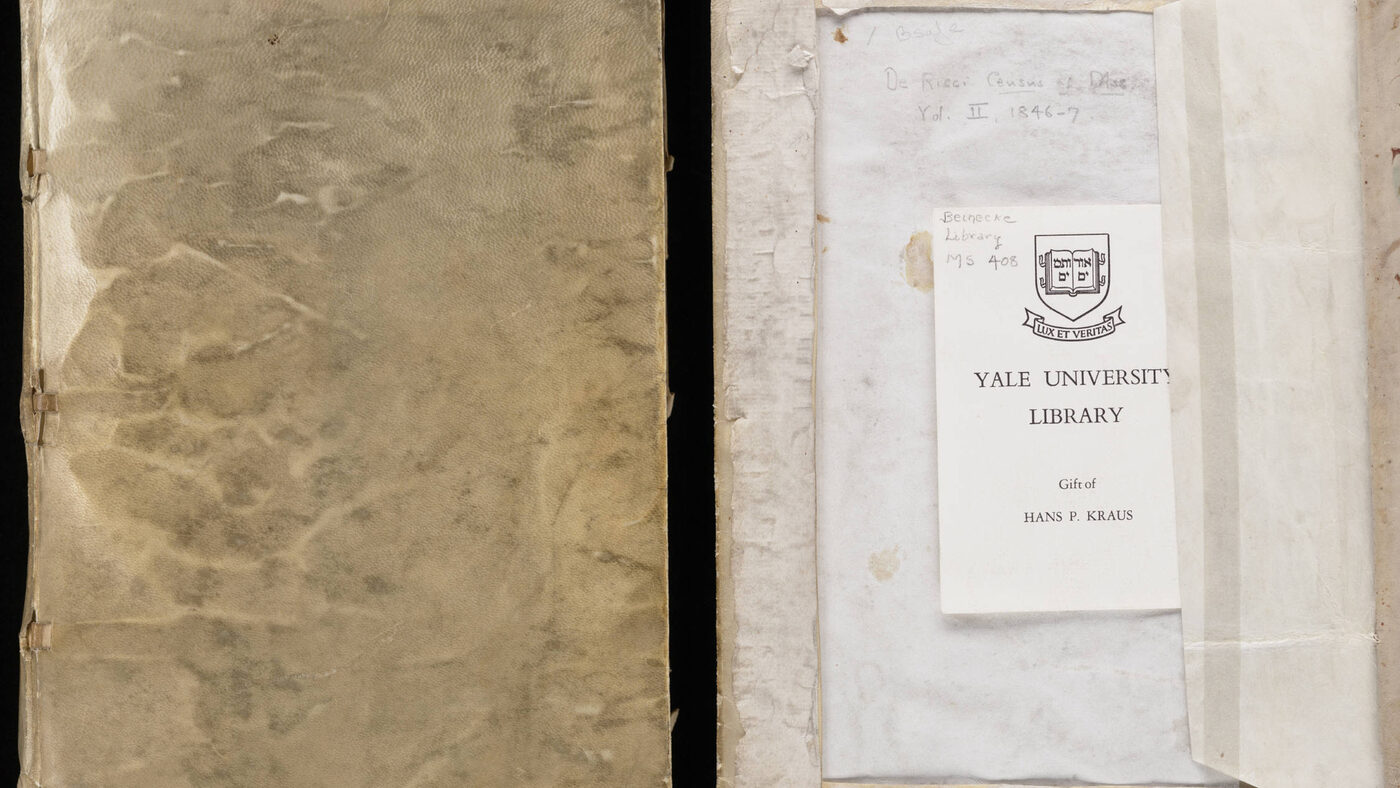
This is the Voynich Manuscript. It is written in a script that appears nowhere else in human history, illustrated with plants that don't exist, stars that match no sky, and a great many small figures bathing in what looks unmistakably like indoor plumbing. It has defeated professional codebreakers, medieval scholars, the people who cracked Enigma, and, lately, artificial intelligence. It is, by a comfortable margin, the most expensively guarded book that nobody can use.
What We Actually Know
Start with what we actually know, which is reassuringly little. The pages are genuine calfskin. In 2009, the University of Arizona carbon-dated them to between 1404 and 1438. So the material is real, and it is early 15th century. That date matters more than it sounds, because it quietly executed the most popular theory of all — that the whole thing was a modern hoax. The skin turned out to be older than the suspicion.
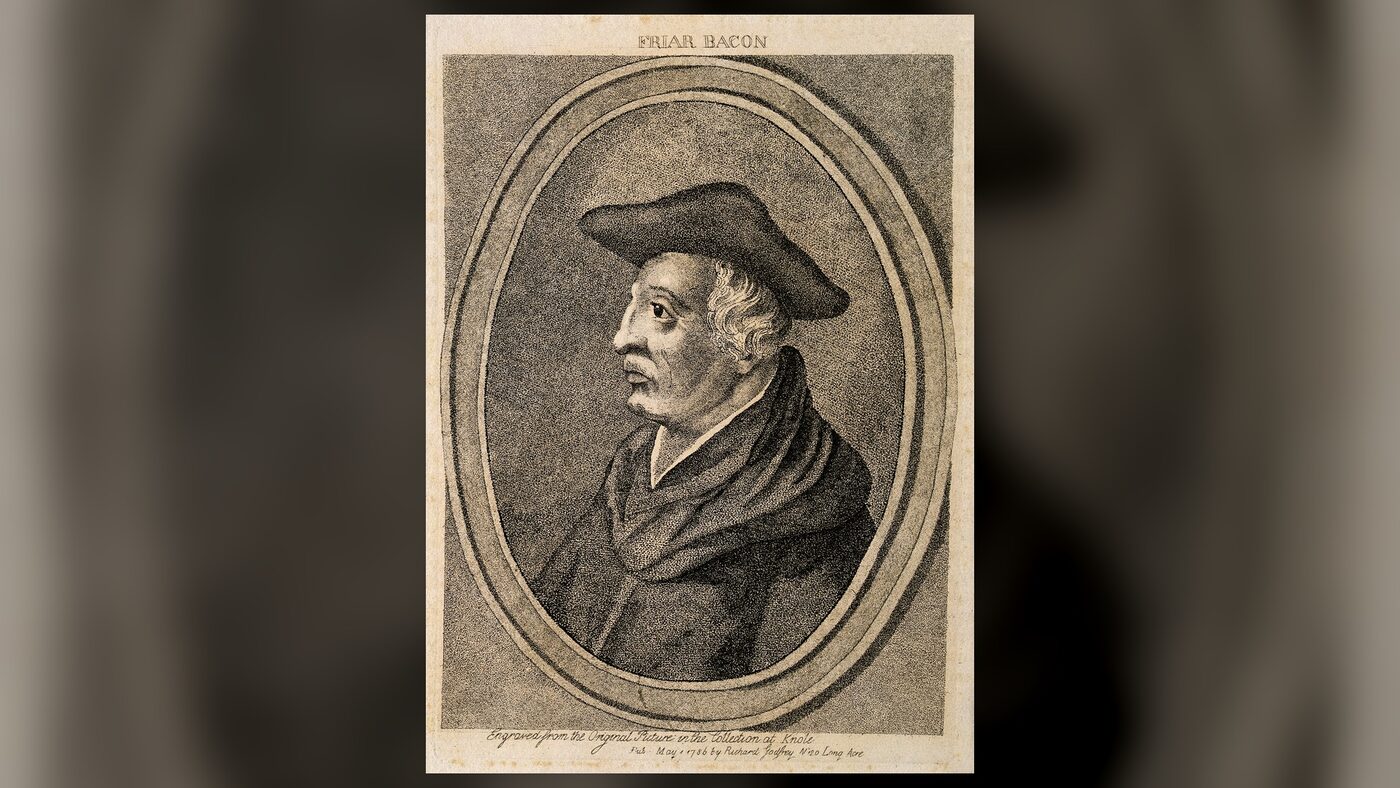
The very first theory was wrong, too. For years, people credited the book to Roger Bacon, a 13th-century friar with a reputation for hidden knowledge. The carbon date put the pages a good century after he died. So the Voynich Manuscript managed to be misattributed before it was even made. It has been generating wrong answers since before the wrong answers were possible.
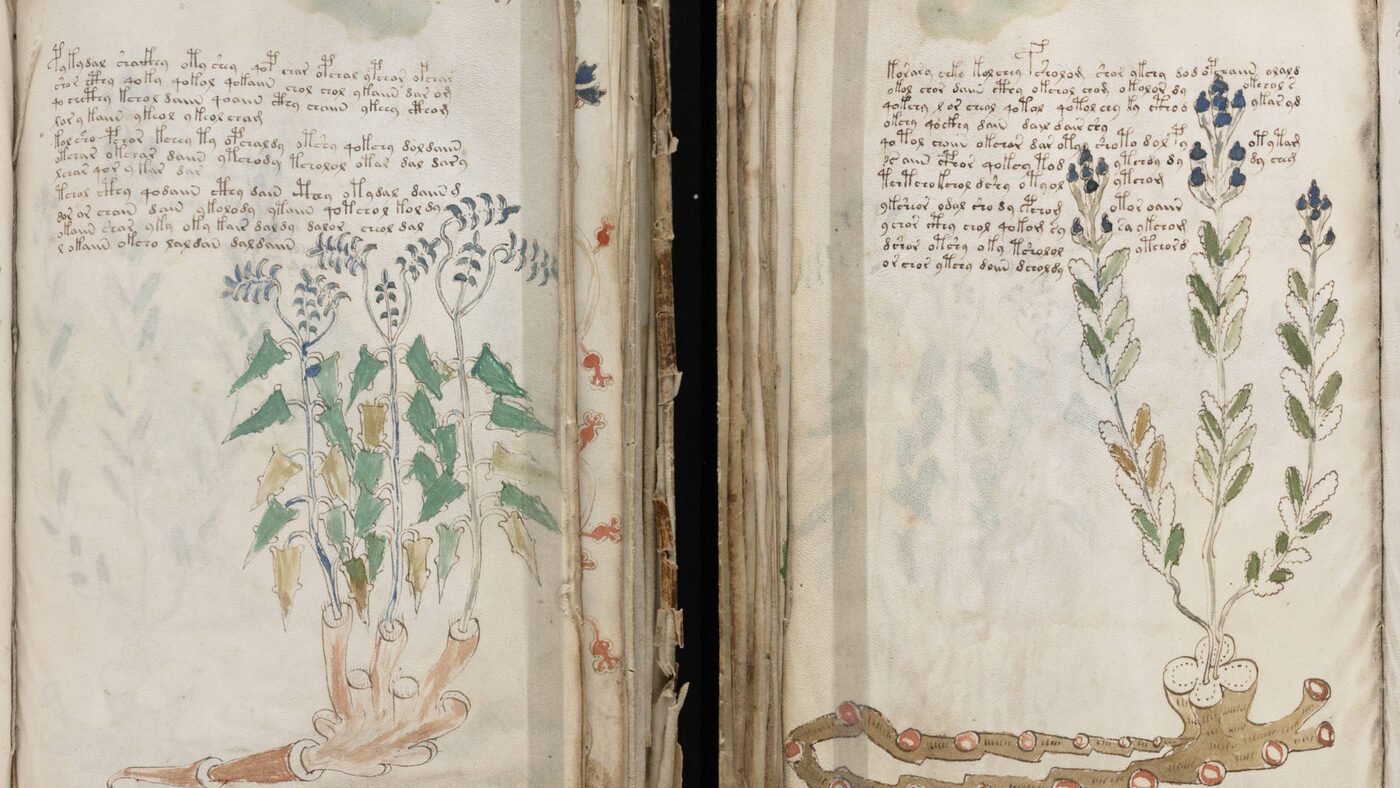
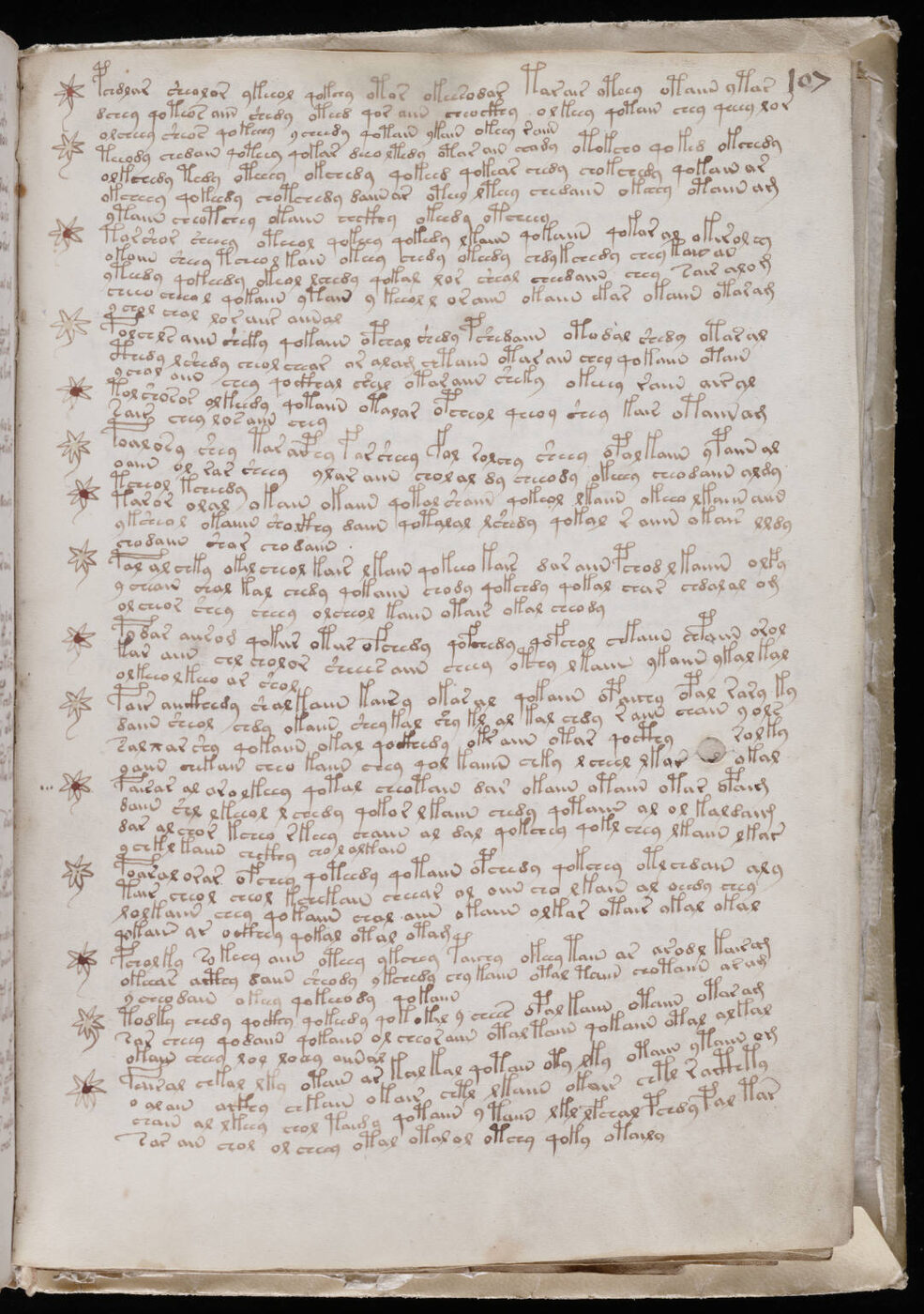
The writing itself is the first real problem. Twenty or thirty distinct characters, flowing left to right in a smooth, confident hand. There are no corrections. No crossings-out, no hesitation, no second-guessing anywhere in 200-odd pages. Whoever wrote this wasn't working it out as they went. They wrote it the way you write a language you know cold. Fluently, in a script no one else has ever seen.
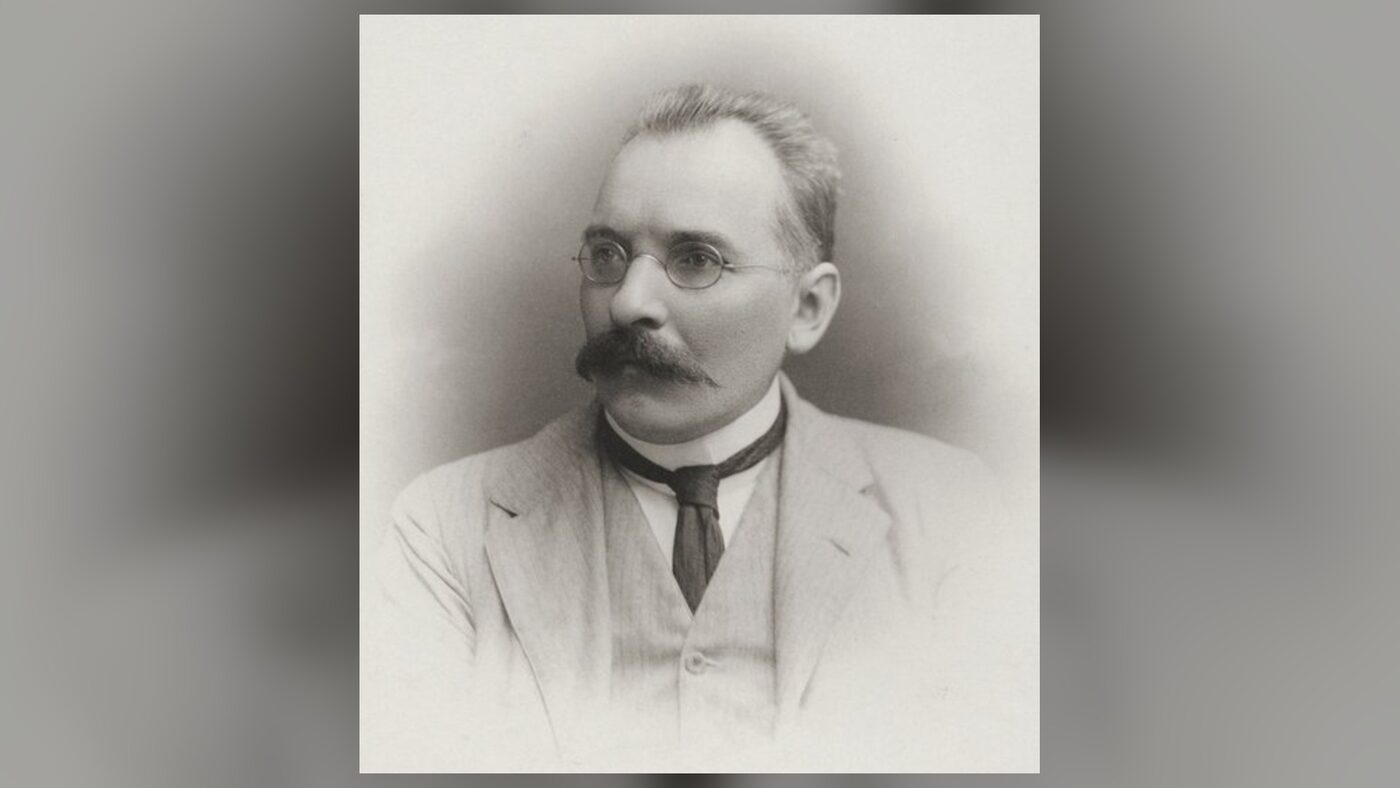
We don't even know who made it, or for whom. The book is named after Wilfrid Voynich, a dealer who bought it in 1912 from a Jesuit college in Italy. He didn't write it. He just owned it recently enough to get his name on it. Trace it backward and it passes through the Holy Roman Emperor Rudolf II, who supposedly paid 600 gold ducats for it, and then the trail goes dark for about 150 years. Even the owners of the unreadable book are a mystery.

The Plants Do Not Exist
About half the book is a botanical guide. Page after page of plants, drawn in detail and colored in — roots, leaves, flowers. Botanists have studied them for over a century. The plants do not exist. A few faintly resemble real species. Most look assembled from spare parts — a real leaf on an invented root — like a field guide to a planet that isn't this one.
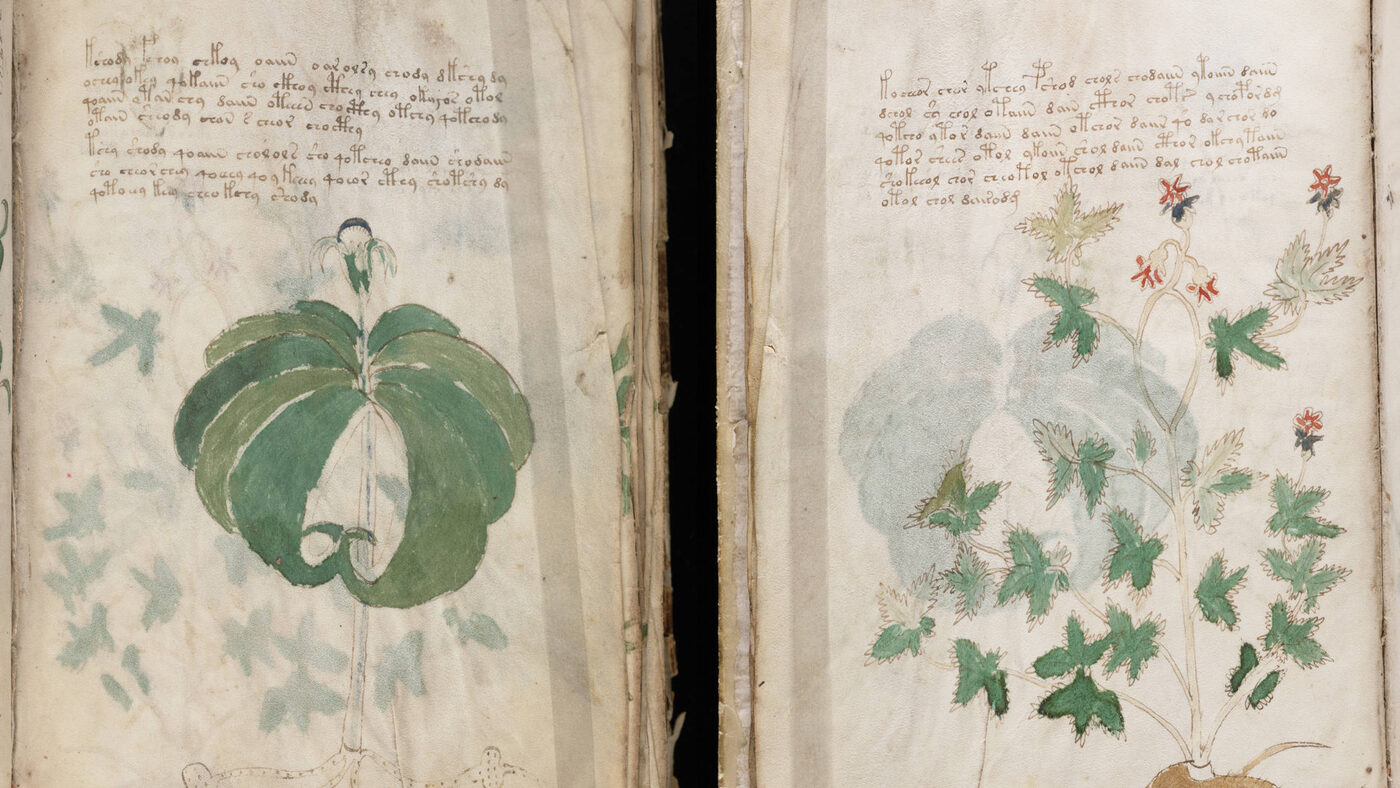
Here is what makes the plants worse, not better. The book is laid out exactly like a real medieval herbal — the genuine plant-and-medicine reference books of the period. Same structure, same instincts, same kind of page. It is a flawless imitation of a useful book. It has simply declined to contain anything useful.
The other sections are just as committed, and just as useless. There are astronomical charts — suns, moons, stars, circular diagrams — whose constellations match nothing in the actual sky. There is a pharmaceutical section, rows of apothecary jars beside neatly clipped plant parts, a catalog of ingredients for recipes nobody can read. Near the back there is a section of short paragraphs, hundreds of them, each marked with a small inked star in the margin, like a checklist or a book of remedies. Everything in the book has the shape of useful information. None of it has the content.
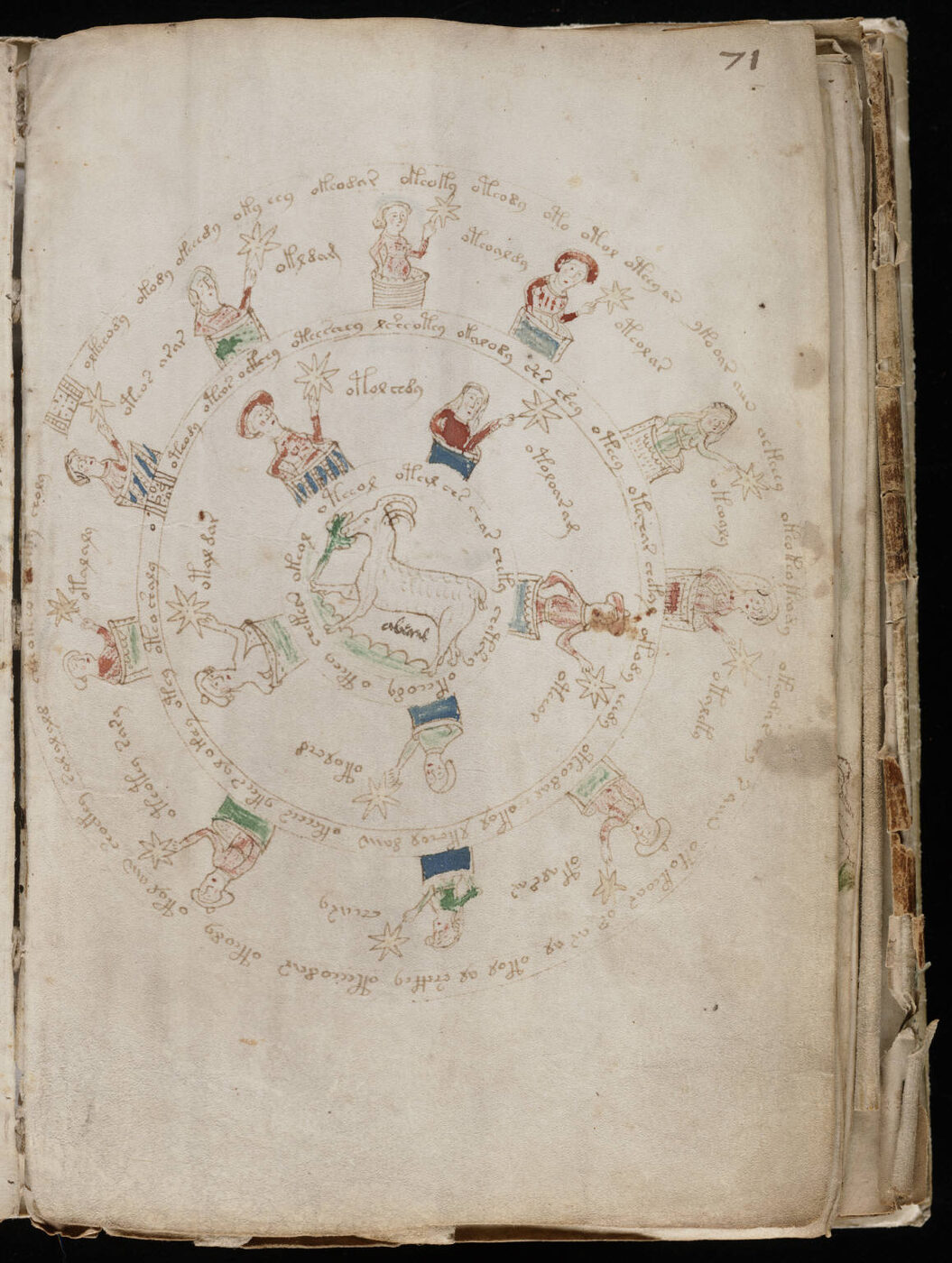
The Figures in the Plumbing
And then there is the section everyone remembers. Dozens of small figures, standing and sitting in pools of green and blue liquid, connected by an elaborate network of tubes and pipes. The scholarly term is "balneological." It means "relating to bathing." In plain terms, it is several pages of people in a green hot tub plumbed into an aqueduct, drawn with total seriousness, and captioned in a language no human can read.
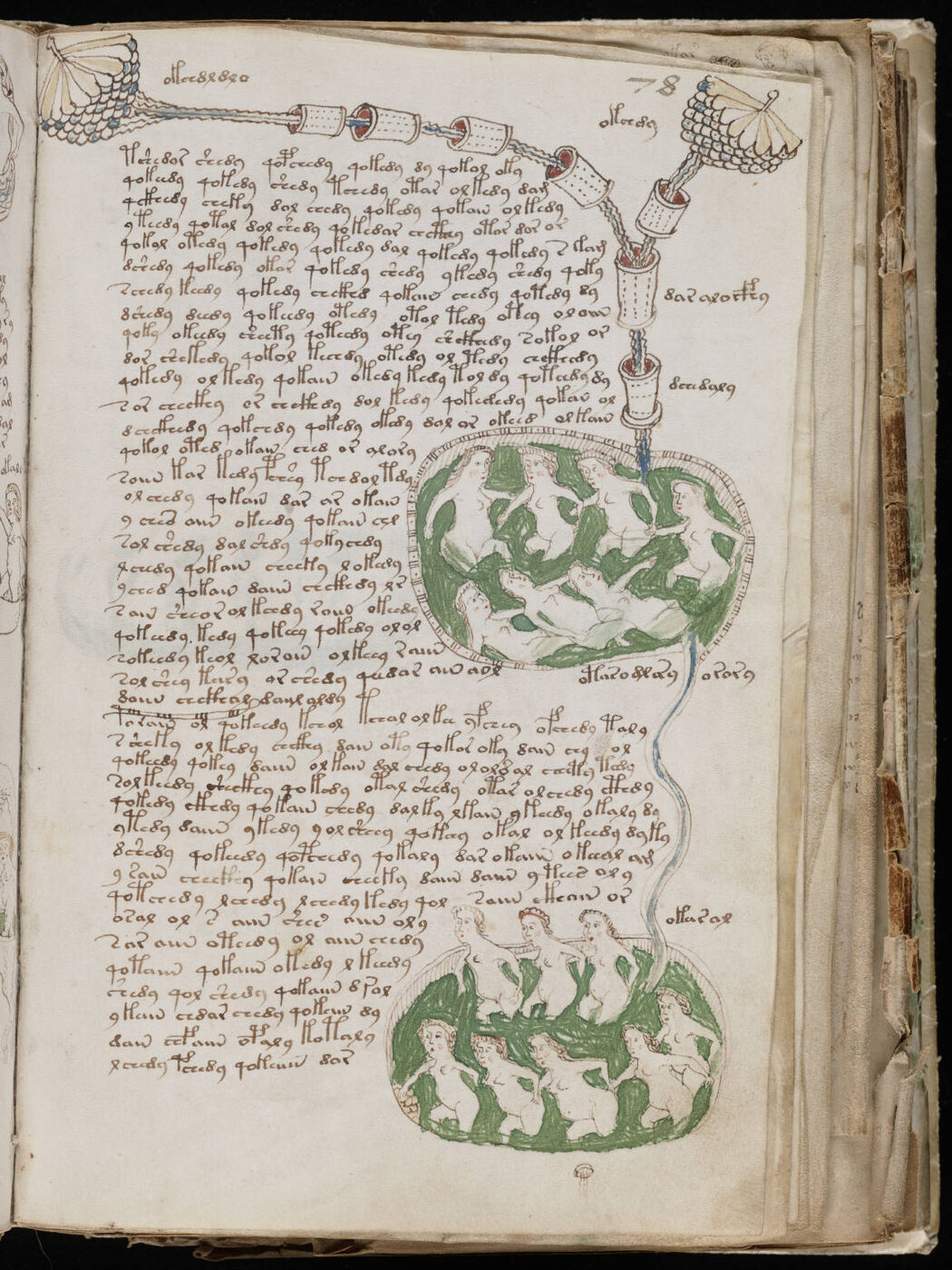
People have spent entire careers on those bathing figures, arguing whether it is medicine, or astrology, or biology, or something with no modern category at all. The most honest answer, after a hundred years of study, is that they are people, in water, doing something. Past that, the field is wide open.
That is the quietly maddening part of all of it. None of this is doodling. The illustrations are careful. The text is disciplined. The whole book is laid out like a serious reference work by someone who plainly believed it meant something. Six hundred years later, we have the reference work — the index, the diagrams, the recipes — and not one usable fact in the entire volume.
It Looks Like a Language
You would expect the obvious answer to be that it is gibberish. Pretty patterns, no meaning. Except the text flatly refuses to behave like gibberish. Run it through the tools linguists use, and it obeys the statistical laws that real languages obey. A few words appear constantly; most appear rarely — the exact distribution you find in English, or Latin. The words even have structure: what look like roots, with prefixes and endings attached. It reads like a language. It just isn't one anyone can find.
And then it breaks the pattern right back. The text is too repetitive. Words sit beside near-copies of themselves far more often than any real language allows. The letters are too easy to predict. One analyst, decades ago, even found the book seems written in two slightly different styles, as if two hands, or two systems, were at work. So it is orderly enough to look real, and strange enough that no real language fits. It has spent six centuries failing to be either meaningful or random.
More recent work complicates even that. A leading scholar identified what look like several different handwritings across the book. Not one author. A few. Which paints a genuinely strange picture: a group of people, sitting together, collaborating carefully, page by page, in a written language that — as far as anyone can prove — not one of them could read to us today.
Everyone Who Solved It
Every few years, somebody solves the Voynich Manuscript. The ritual is always the same. A confident announcement. A wave of headlines. And then, usually within about 72 hours, the specialists take it apart. It has been solved more times than almost any document in history. It remains, at all times, unsolved.
In 2017, a researcher announced it was a women's health manual in abbreviated Latin. Experts pointed out his sample translations didn't produce actual Latin. It quietly went away. Two years later, in 2019, another scholar declared it was a lost tongue called proto-Romance, cracked, he said, in two weeks. Proto-Romance isn't a recognized language. His own university put out a press release celebrating the breakthrough — and then, within days, retracted its own press release.
Lately the announcements arrive with artificial intelligence bolted on. A neural network matches the text to Hebrew, or Old Turkish, or one more lost language, and the headline writes itself. The translations don't hold up either. The Voynich Manuscript has now defeated the best codebreakers of the analog age and the best pattern-matching machines of the digital one, with precisely the same result. Nothing.
To be fair, not everyone who tried it was reckless. One careful linguist spent years on it and claimed only a handful of words — a plant here, a zodiac sign there — matched to the pictures drawn beside them. He never once said he had solved it. And that is the tell. The people who study the Voynich the longest are the least willing to claim they have cracked it. Here, confidence and progress point in opposite directions.
Or Maybe It's Nothing
Which leaves the uncomfortable possibility that it says nothing at all. One researcher showed you could generate Voynich-like nonsense with a simple period trick — a stencil full of holes, slid over a table of syllables to spit out plausible-looking fake words. A clever con, in other words, sold to a wealthy buyer who wanted a book of secrets. It is a good theory. It has one problem. The stencil trick, the so-called Cardan grille, was invented about a hundred years after the pages were made.
And the book has been beating people for a very long time. In the 1600s it landed with Athanasius Kircher, a Jesuit scholar famous for claiming he could read Egyptian hieroglyphs. He couldn't actually read those either, as it turned out. But he gave the Voynich a serious try and got exactly as far as everyone before and since. The finest decoders of every century have looked hard at this book and produced, between all of them, one long, unbroken line of nothing.
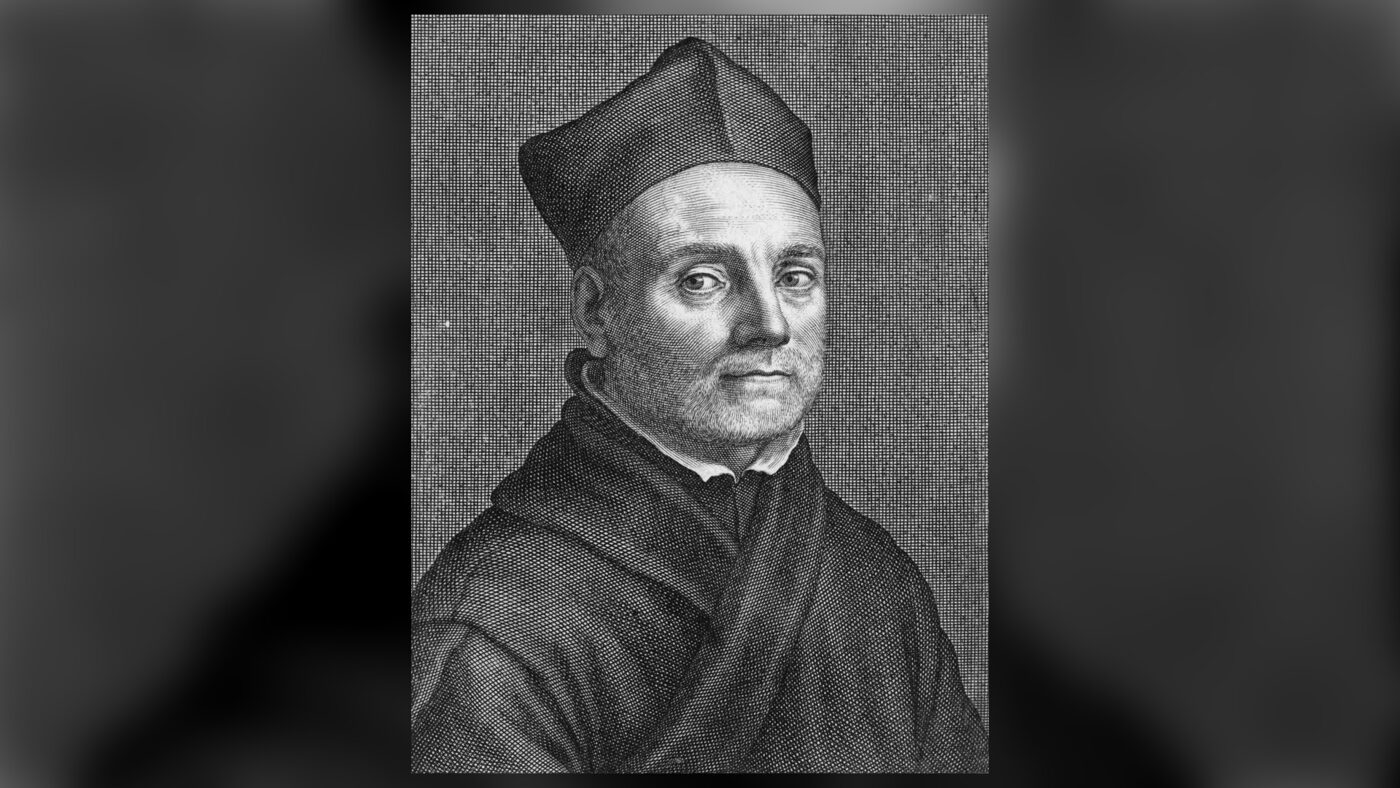
There may be nothing in it to find. That is the possibility the experts like least, and can't rule out. Six hundred years of genuinely brilliant people may be losing, slowly, to a very elaborate practical joke — or to a real language, written by someone who took the meaning into the grave and pulled it in after them.
Still Unread
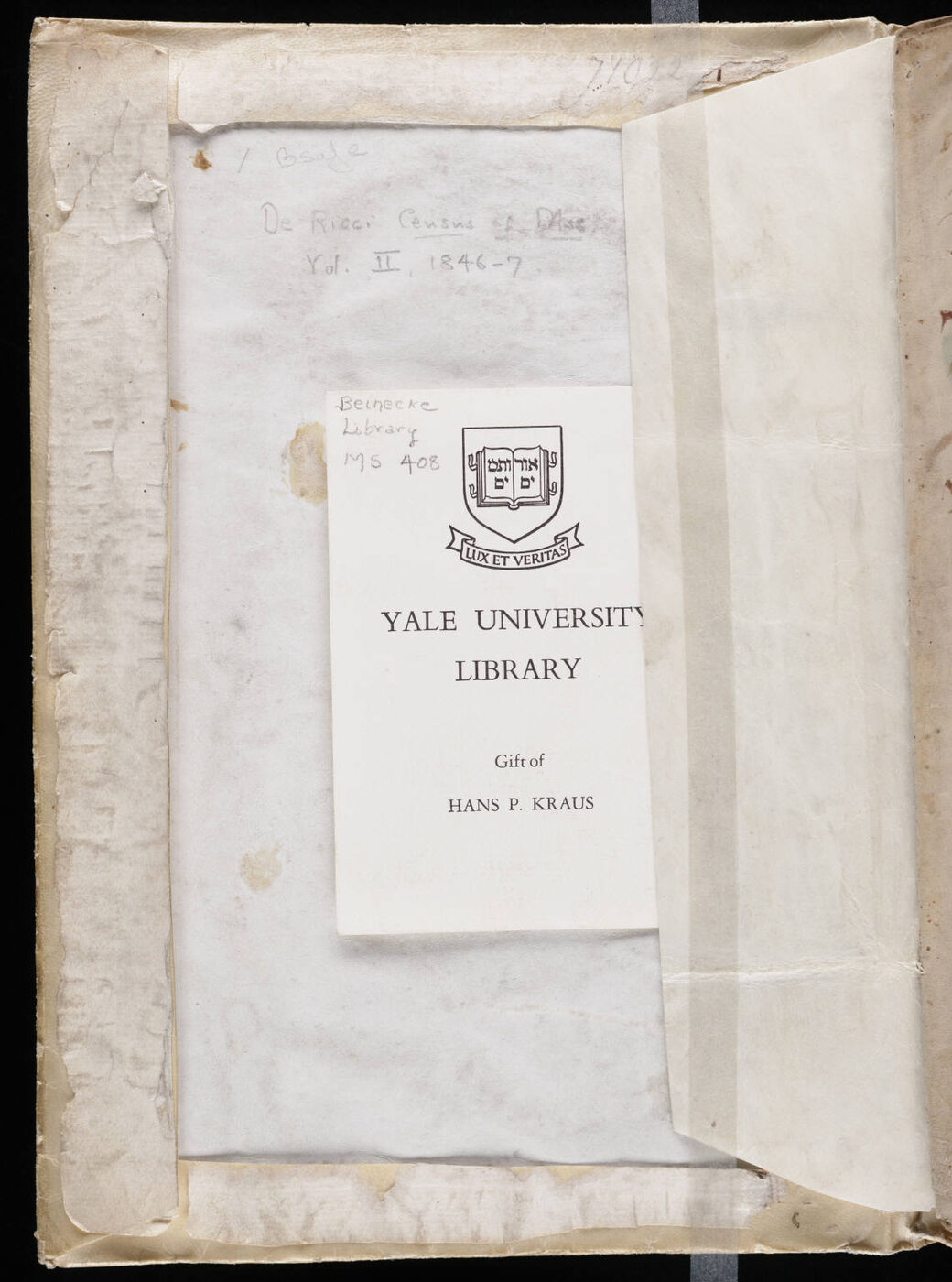
The manuscript sits at Yale's Beinecke Rare Book and Manuscript Library to this day, catalogued as MS 408. It is handled rarely, kept at a careful temperature, and photographed in high resolution so the whole world can study every stroke and understand none of it. It isn't even complete. Around 14 of its pages are missing.
Part of why it won't leave us alone is that it sits in a very specific blind spot. Old enough to matter. Complete enough to look solvable. And just barely too strange to crack. It offers exactly enough to keep clever people coming back, and exactly nothing to reward them with. The most unreadable book in human history is also, somehow, abridged. Six hundred years in, the plants still don't exist, the figures are still in the plumbing, and the book is still, very patiently, keeping its one and only secret.
Sources & Case References
- Beinecke Rare Book & Manuscript Library, Yale University — Voynich Manuscript (MS 408)
- Encyclopædia Britannica — "Voynich manuscript"
- Smithsonian Magazine — "Why the Mysterious Voynich Manuscript Has Eluded Decipherment"
- University of Arizona News — "UA Experts Determine Age of Book 'Nobody Can Read'" (2011)
- The Guardian — "Solution to Voynich manuscript? Experts say not so fast" (2019)
- Manuscript page images: Beinecke Rare Book & Manuscript Library, Yale University (MS 408), public domain. Portraits via Wikimedia Commons (Wilfrid Voynich, Rudolf II, Athanasius Kircher — public domain); Roger Bacon engraving courtesy the Wellcome Collection (CC BY 4.0).