On the evening before Thanksgiving, 1971, a man in a dark suit boarded a short flight from Portland to Seattle, sat in the back, and ordered a bourbon and soda. He was calm, polite, unremarkable. Middle-aged. A briefcase on his lap. Partway through the flight, he handed the stewardess a note. She assumed it was a lonely man's phone number and slipped it into her pocket, unread. He leaned over and told her she had better look at it. The note said he had a bomb.
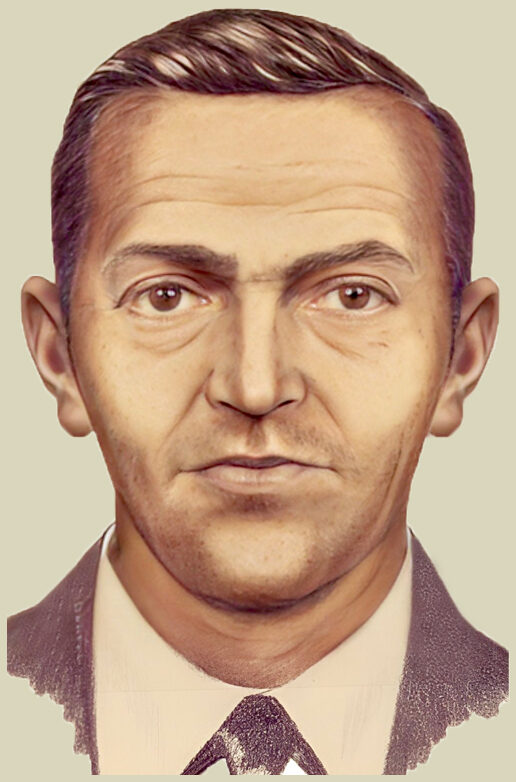
What followed is the only unsolved skyjacking in American history. He took $200,000 and four parachutes, released the passengers, and then, somewhere over the dark woods of Washington State, opened the back of the plane and stepped out into the night. He was never found. He had bought his ticket under the name Dan Cooper. A wire-service error turned that into D.B. Cooper, and the wrong name, like first impressions do, stuck. So the most famous hijacker in history is known, to this day, by a typo. Fitting, for a man who left almost nothing else behind. Almost nothing. He left a clip-on tie, on the seat. And, eventually, a piece of the airplane that had to be redesigned because of him. That is the entire estate of D.B. Cooper: a tie, a typo, and a safety device.
A Bourbon and Soda
The note was neat and businesslike. He had a bomb in the briefcase, it said, and he opened it briefly to show her — a glimpse of wires and red cylinders. His demands were specific. Two hundred thousand dollars, in twenties. Four parachutes. A fuel truck waiting in Seattle. He was, by every account, unfailingly polite about all of it.
The plane circled Seattle while the money and chutes were gathered. He asked for two main parachutes and two reserves, which mattered: asking for four suggested he might force a hostage to jump with him, so no one would dare hand him a sabotaged chute. A careful request. Whatever else Cooper was, he was not improvising.
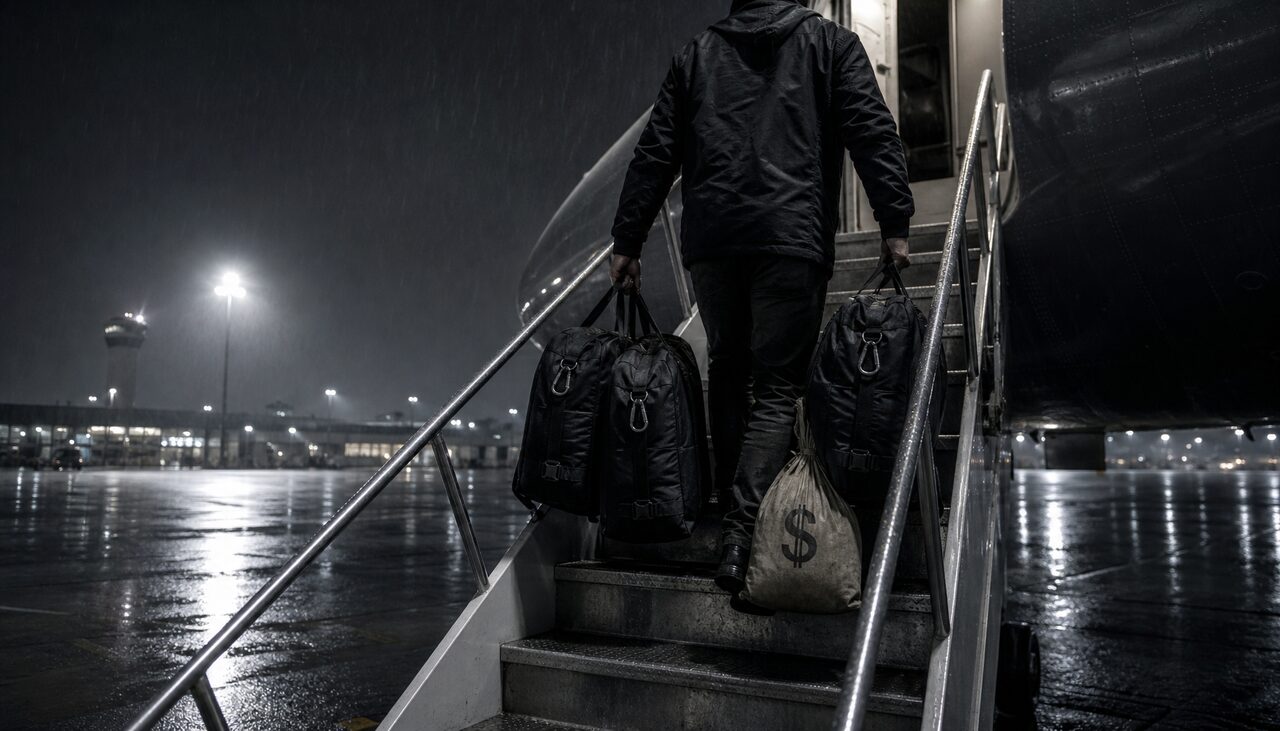
On the ground in Seattle, he kept his word. He released all thirty-six passengers and two of the flight attendants. He had his bourbon and paid his tab. He even offered the crew meals. It remains the most courteous act of air piracy on record. Then he gave the pilots their instructions, and they were unusual. Fly toward Mexico City. Stay below ten thousand feet. Flaps at fifteen degrees. Landing gear down. Cabin unpressurized. He was asking them to fly slow, and low, and loose — the configuration of an aircraft you intend to jump out of. He sent the crew to the cockpit and told them to stay there. Alone in the cabin, he lowered the rear staircase of the Boeing, in flight, into the freezing dark. The 727 was one of the only airliners you could do that with. He had chosen his aircraft, it seems, as carefully as everything else.
The Jump
It was a terrible night to jump. Rain, heavy cloud, wind, a temperature near freezing, and a windchill far below it at the open stairs. Below, there was nothing but black forest and mountains. He was wearing a business suit and loafers. No helmet, no jumpsuit, no boots, no light.
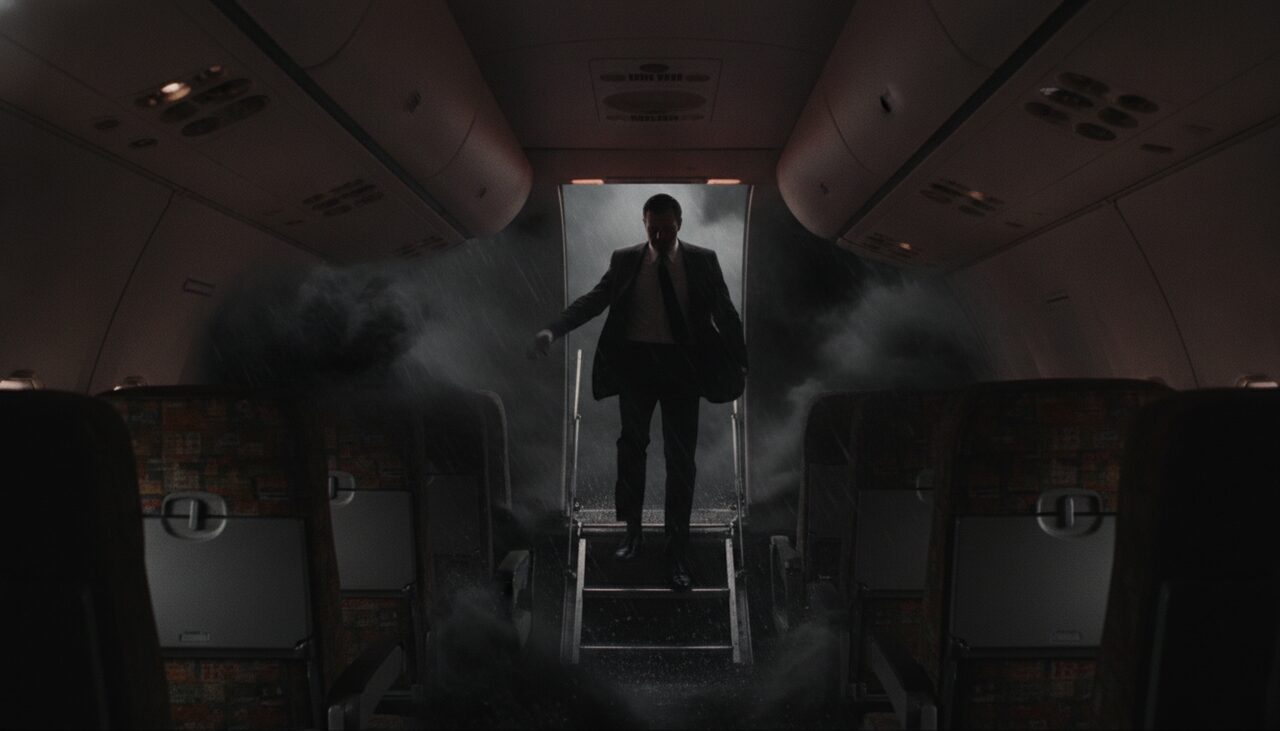
Around eight in the evening, the crew felt the plane bob — a change in pressure, a shift in trim, as a weight left the aft stairs. When they landed, the stairs were down, the money was gone, and so was Cooper. He had taken the cash, two of the four parachutes, and a borrowed name. He left the reserves, one of which had been sewn shut as a training dummy. He had taken a working one. He knew the difference. Then the largest manhunt of its kind began, and found nothing. Military, FBI, search planes, ground teams, combing the drop zone for months. No body. No parachute. No money. No suit. A man had jumped into a defined patch of wilderness, and the wilderness had simply closed over him.
Norjak
The FBI called the case Norjak. Over forty-five years, agents considered more than a thousand suspects and seriously pursued dozens. Confessions, deathbed claims, tips from ex-wives, amateur theories by the hundred. Everyone, eventually, knows a guy who was probably D.B. Cooper.
A few suspects were genuinely interesting. One man staged an almost identical hijacking months later, was caught, and turned out to be an experienced parachutist. He fit almost perfectly. He also, the FBI concluded, probably was not Cooper — just an admirer who had taken notes. Cooper had invented a crime good enough to franchise. In the months after, a wave of copycats tried the same trick: note, bomb, ransom, parachute. Most were caught. None vanished. Cooper made it look easy, and proved, by everyone who failed to repeat it, that it was not.
The named suspects came and went. A dying man whose family was certain. A veteran with a grudge. A man whose own relatives turned him in, decades on. Each had a believer, a documentary, a theory. None had the one thing that would close it — a match, to anything. In 2016, the FBI gave up. It formally suspended the active investigation after forty-five years, the longest unsolved case of its kind. Not closed. Suspended. The bureaucratic way of saying we have no idea, and we have stopped paying people to find out. The file is open, and empty, which is the worst way for a file to be.
$5,800 on a Beach
Now the money. In 1980, an eight-year-old boy on a family outing was building a campfire on a sandy bank of the Columbia River. He smoothed the sand and uncovered three bundles of rotting twenty-dollar bills — five thousand, eight hundred dollars, give or take. The serial numbers matched the ransom, exactly.

It was the first, and almost the only, physical trace of D.B. Cooper ever recovered. And it raised more questions than it answered. The bundles were still banded, decayed in a way that suggested they had arrived not long before, by water. But the spot did not sit neatly downstream of the drop zone. The river and the math did not agree. Every theory breaks on that beach. If Cooper died on the jump, how did a fraction of the money reach there, years later, and nowhere else? If he lived, why lose part of it, and never spend a marked bill anywhere on Earth? Not one of the ransom bills has ever turned up in circulation. Not one, in over fifty years. The money is too little to be his savings, too much to be a coincidence, and in the wrong place for either. It is the single hardest fact in the case, and it points, faintly, in no direction at all.
The Tie
Which leaves the tie. Before he jumped, Cooper took off his clip-on and left it on the seat. A clip-on. The hijacker of the century could not be bothered with a real knot. For decades it was just an exhibit. Then amateurs got hold of the science.
A team of citizen investigators, with a microscope and patience, went over the tie and found thousands of microscopic particles: rare-earth metals, titanium, pure and unusual and industrial. The kind you pick up working around aerospace manufacturing. In 1971, that sort of titanium work pointed to a short list of employers — one of which, in that region, was Boeing. Whose airplane he had just jumped out of. There was DNA on the tie, too — a partial sample recovered years later. Which sounds like the end of the story, until the caveat: they cannot be sure the sample is even Cooper's. A clip-on tie is handled by clerks, salesmen, and strangers before it ever reaches a hijacker's collar. The one sample that might name him could belong to a department-store cashier.
It is a tantalizing thread. It suggests Cooper was not some drifter but a man with a technical job, who understood aircraft, parachutes, and pressure — which fits the careful demands, the chosen aircraft, and the configuration he ordered. It narrows him, from anyone, to a particular kind of someone. An engineer who decided, one Thanksgiving, to leave by the back door. But a kind of person is not a person. The particles point at an industry, not a name. It is the most modern, most scientific lead in the case, and it still does not knock on a single door.
The Man Who Died
There are really only two endings, and the first is grim. He died that night. An amateur — and the evidence says amateur — out the back of a jet, at night, into a freezing storm, over mountains, in a business suit and loafers. No light to find the ripcord. No way to see the ground come up. The cold alone could have finished it before he ever reached the trees.
It is the likeliest reading, and for years it was the FBI's. It asks for no genius and no luck — just a man who overestimated himself, and a forest that kept the body. But the forest is the problem. That drop zone became the most thoroughly searched patch of wilderness in American history: soldiers, dogs, aircraft, grid searches for months, amateurs for decades after. And the body, the parachute, the suit, the $200,000 — none of it has ever been found. The likeliest ending has one flaw. It left nothing behind, in the one place we looked hardest.
The Man Who Lived
The other ending is the one everyone wants. He landed hard, somewhere in the dark, and he walked out. Buried the suit, kept his mouth shut, and went back to an ordinary life — a man at a hardware store, a neighbor who mowed his lawn, carrying the best secret in America to a completely unremarkable grave. And it is not impossible. Months later, a copycat ran almost the exact same play, jumped into the same kind of night, and lived. So the jump was survivable. Someone survived it. Just, provably, not Cooper.
But this ending has its own flaw, and it is the money. Not one of those marked bills has ever surfaced — not in a bank, not at a racetrack, not anywhere, in fifty years. So the man who supposedly got away clean sat on $200,000 and never spent a marked dime of it. Which is either superhuman discipline, or the discipline of a man who was no longer in any position to spend anything at all. The living Cooper has to explain the money. And the only clean explanation for the money is that he died.
The Cooper Vane
He changed the airplanes themselves. After Cooper, and his copycats, the airlines bolted a simple mechanical device to the aft stairs of the 727 — a wedge that the air itself forces shut once the plane is moving, so the stairs cannot be lowered in flight. It is called, officially, the Cooper vane. He is the only criminal in history with an aircraft part named after him.
That is the strange size of his legacy. No name. No body. No spent money. But a permanent change to how every one of those jets was built, a typo that became a legend, and a tie under a microscope. He escaped so completely that he left only the shape of his absence. Two endings, then — a dead genius no one can find, or a live one no one can name. Both unprovable. Both leaving one thing unexplained. That is the reward for leaving no body: you do not have to pick. In the public mind, the careful man just keeps walking. Out of the frame, off the edge of the map, into the trees. He left a tie. It was a clip-on. Fifty years later, it is still the most we know about him.
Sources & Case References
- FBI — "D.B. Cooper Hijacking"
- Wikipedia — "D. B. Cooper"
- Image credits: the FBI composite sketch and FBI wanted poster are works of the U.S. federal government and are in the public domain (via Wikimedia Commons).