On July 8, 1947, the public information office at Roswell Army Air Field issued a press release stating that the base had recovered a flying disc. The local paper, the Roswell Daily Record, ran it that afternoon under the headline "RAAF Captures Flying Saucer On Ranch in Roswell Region." The Army said it in writing, on its own letterhead, and put a name to it. This is the one part of the Roswell story on which every side agrees.
By the next morning the Army would have preferred that nobody remembered it had said anything at all.
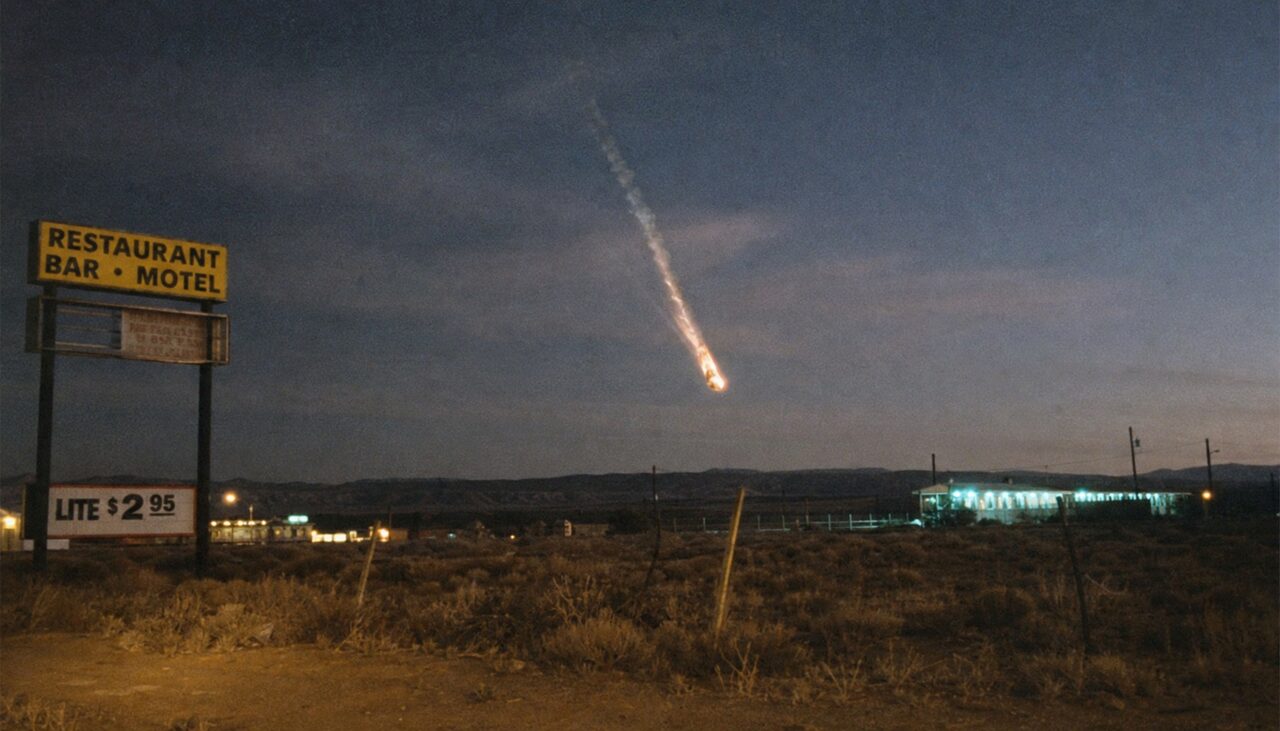
What followed is close to eighty years of the United States military explaining what it had meant to say. It has now done this three separate times. Each explanation is documented. None of them is the same one, and that fact has kept the case open longer than any of the explanations have lasted.
The timing did most of the work. Two weeks earlier, on June 24, 1947, a private pilot named Kenneth Arnold reported nine bright objects skipping past Mount Rainier in Washington State. A reporter rendered his description as "flying saucers," and the phrase went off across the country like a flare. By July the public was already looking up. Roswell simply gave them an address to point at.
The Pasture
It started with a rancher. Mac Brazel ran the Foster ranch, about seventy-five miles from town. One morning in early July he found a stretch of pasture scattered with debris — foil, rubber strips, thin wooden sticks, and a kind of tape printed with faint flower-like figures along it.
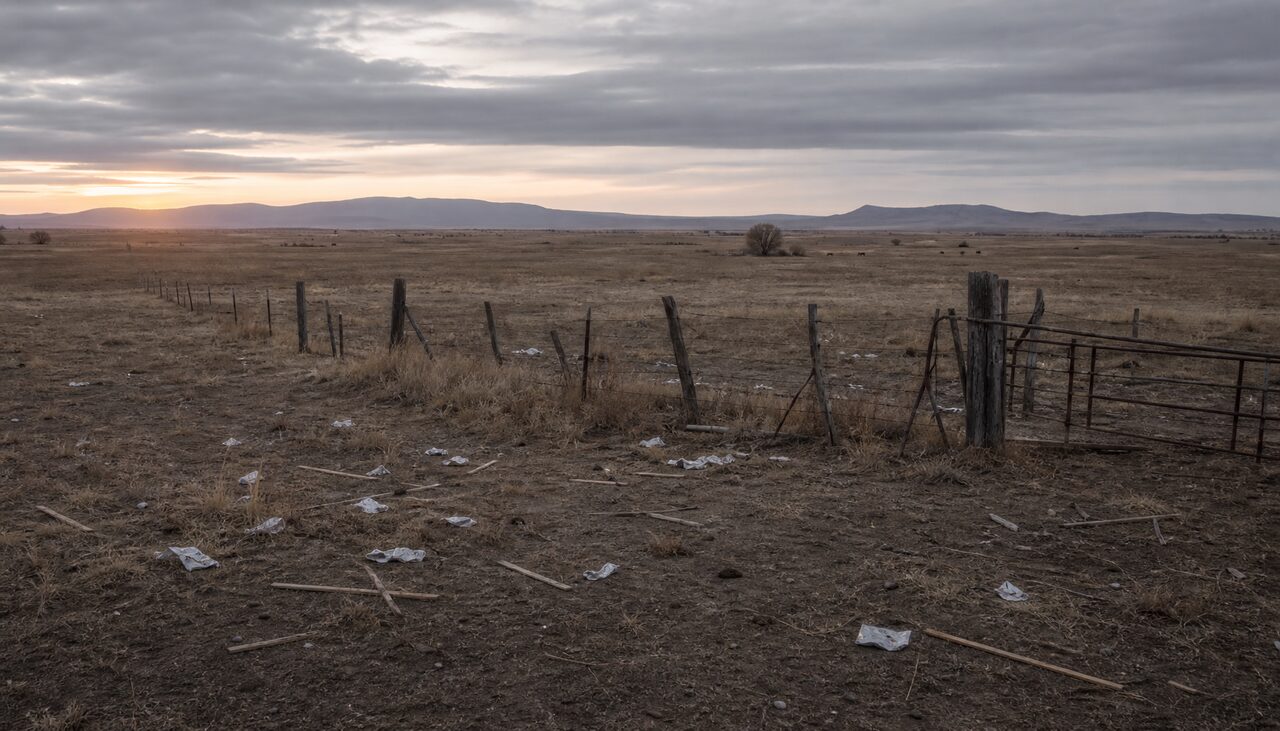
It was strange enough that Brazel loaded some of it into his truck and drove it into town to show the sheriff, who called the air field. The air field sent Major Jesse Marcel, the bomb group's intelligence officer, out to the ranch to collect the rest. Marcel filled his car with foil and sticks and drove it back to base. That much is in the record.
The famous part is not. Years later, Marcel described the foil: you could wrinkle it, he said, but you couldn't crease it, dent it, or burn it, and it always settled back flat. He called it memory metal, and it became the single most quoted sentence in the whole affair. It's worth noting when he said it — not in 1947, but in 1978, thirty-one years after the fact, to a UFO researcher who had sought him out. Memory metal, recalled from memory.
The other man at the pasture remembered it differently. Sheridan Cavitt, the counterintelligence officer who rode out with Marcel, later gave a sworn statement saying he had thought at the time — and still thought — that the debris was a crashed balloon. Two men, one pasture, two memories. We will come back to the balloon.
It helps to know what else was in Roswell in 1947. The base was home to the 509th Bombardment Group, at the time the only military unit on Earth that had ever dropped an atomic bomb. The most sensitive hardware on the planet sat a few miles from that pasture. A place like that does not keep a relaxed attitude toward unidentified debris. The secrecy there was not a conspiracy. It was the job description.
Brazel paid for the attention. After he talked, the military brought him onto the base and held him there for several days, asking the same questions. When he came out, his account had changed and his appetite for telling it was gone. Believers read that as intimidation. Skeptics read it as a rancher who had realized he'd cost everyone a week over a busted balloon. Brazel himself mostly stopped talking.
Two Press Releases
The flying-disc release went out under the name of the base's public information officer, Walter Haut, with his commander's approval. Whatever the debris actually was, the men closest to it looked at it and reached, at once, for the words "flying disc." That is either very revealing or very embarrassing, depending entirely on who you ask.
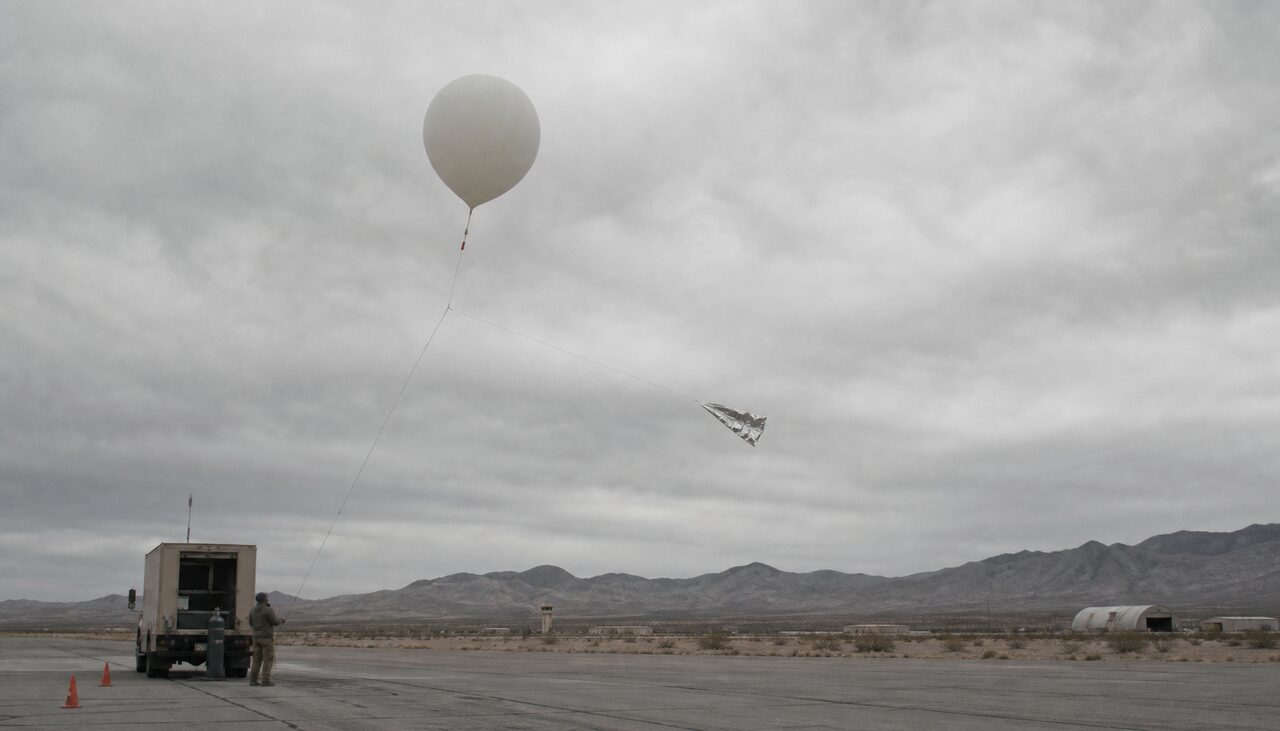
The story went national within hours. By the time it hit the wires, the debris was already moving up the chain of command to Fort Worth, Texas, where General Roger Ramey took one look and issued a second statement. It was a weather balloon — a standard radar target, foil on a balsa frame, used to track wind. Ramey posed for the photographers holding the foil himself. The same material that, one room over, had been called interplanetary was now a prop in a reassurance photo.
It worked. The press moved on. The headline became a one-day embarrassment, filed and forgotten. For roughly thirty years, the most famous UFO case in history was a dead story about a weather balloon. Nobody was chasing it, because there was nothing to chase.
One photograph from Fort Worth has been studied ever since. In it Ramey holds a sheet of paper, and on that paper, just at the edge of legibility, are a few typed words. Enthusiasts have spent decades enhancing it, reading into the blur words like "victims" and "weather balloons." Forty years of image processing has produced about forty different transcripts. The memo tends to say whatever the person enhancing it already believed.
The weather-balloon story got one thing right and one thing wrong. It was right that the debris came from a balloon. It was wrong about which balloon. The truth was still classified, and would stay classified for nearly half a century.
Thirty Years Later
The story came back the way these stories do — through one interview. In 1978, the UFO researcher Stanton Friedman sat down with the retired Major Marcel, who said the debris had never been a weather balloon and that he'd been made to pose with a fake.
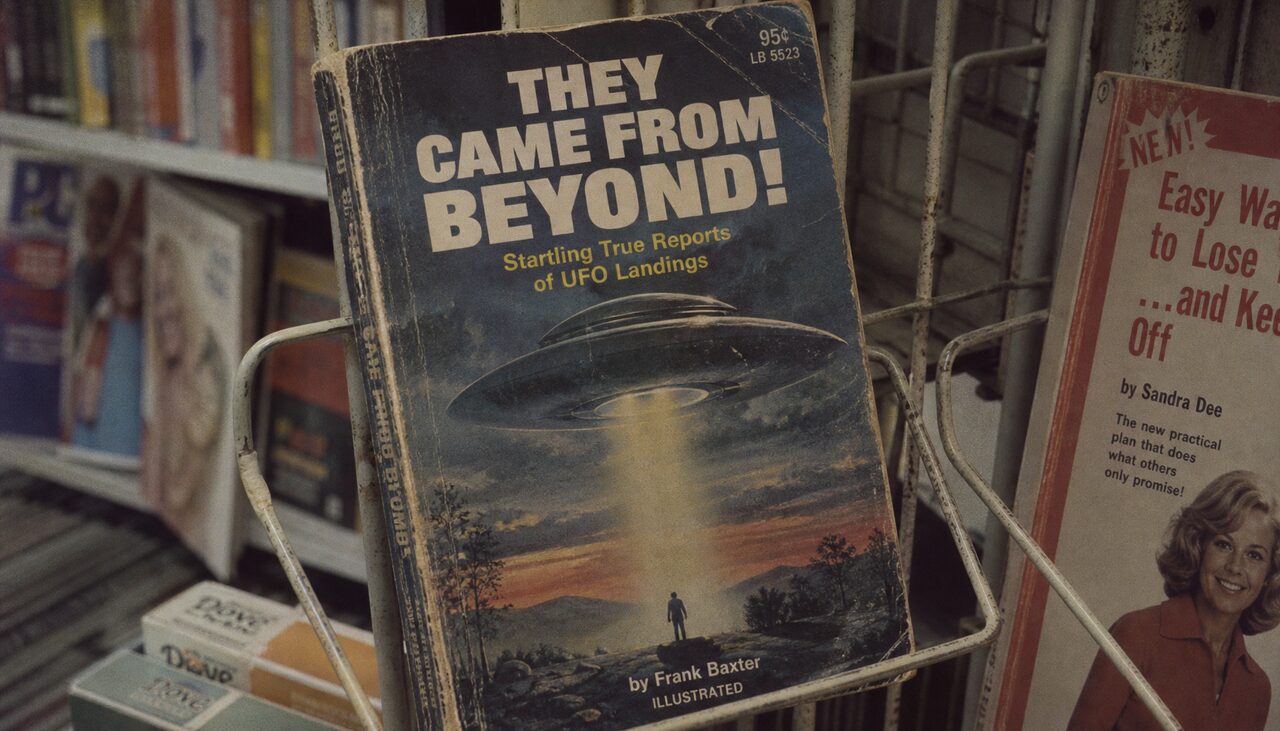
Two years later, that interview became a book: The Roswell Incident (1980), by Charles Berlitz and William Moore — the same Berlitz who wrote The Bermuda Triangle and co-wrote on the Philadelphia Experiment. They had a formula, and Roswell fit it. The book reintroduced the debris and then added details the 1947 story had never carried: a second crash site, bodies, small ones, and witnesses located decades later who recalled being told to keep quiet.
Then it accelerated. By the 1990s there were claims of a government autopsy, a surviving creature, and a cover-up reaching the highest levels. In 1995 a film surfaced that claimed to show the autopsy itself. The man who produced it, Ray Santilli, later said it was a "reconstruction" of footage he claimed once existed.
None of the bodies appear in the original reporting — not in the press releases, not in the Daily Record, not in Brazel's account of his own pasture. They arrived later, in the retelling. The best parts always show up last.
Even Walter Haut came back around. For fifty years he said he had simply typed up what he was handed. Then, in an affidavit sealed until after his death in 2005, he claimed he had personally seen the craft and the bodies. The confession that couldn't be questioned arrived precisely when he could no longer be questioned. A brave last word or a convenient one, depending on your faith.
There were also the documents. In the 1980s, photographs of leaked papers circulated describing a secret committee called Majestic 12, supposedly formed to manage the recovered craft. They named real officials and used real letterhead. They also used a date format the government never used and a signature apparently lifted from another letter. The FBI examined them and stamped them, in plain block letters, "BOGUS."
By the early 1990s a New Mexico congressman, Steven Schiff, was receiving enough mail about it that he asked the government to go and find out what had actually crashed. Which, for once, the government did. Twice.
Project Mogul
The first report came in 1994. The Air Force went into its own archives and came back with a name: Project Mogul.
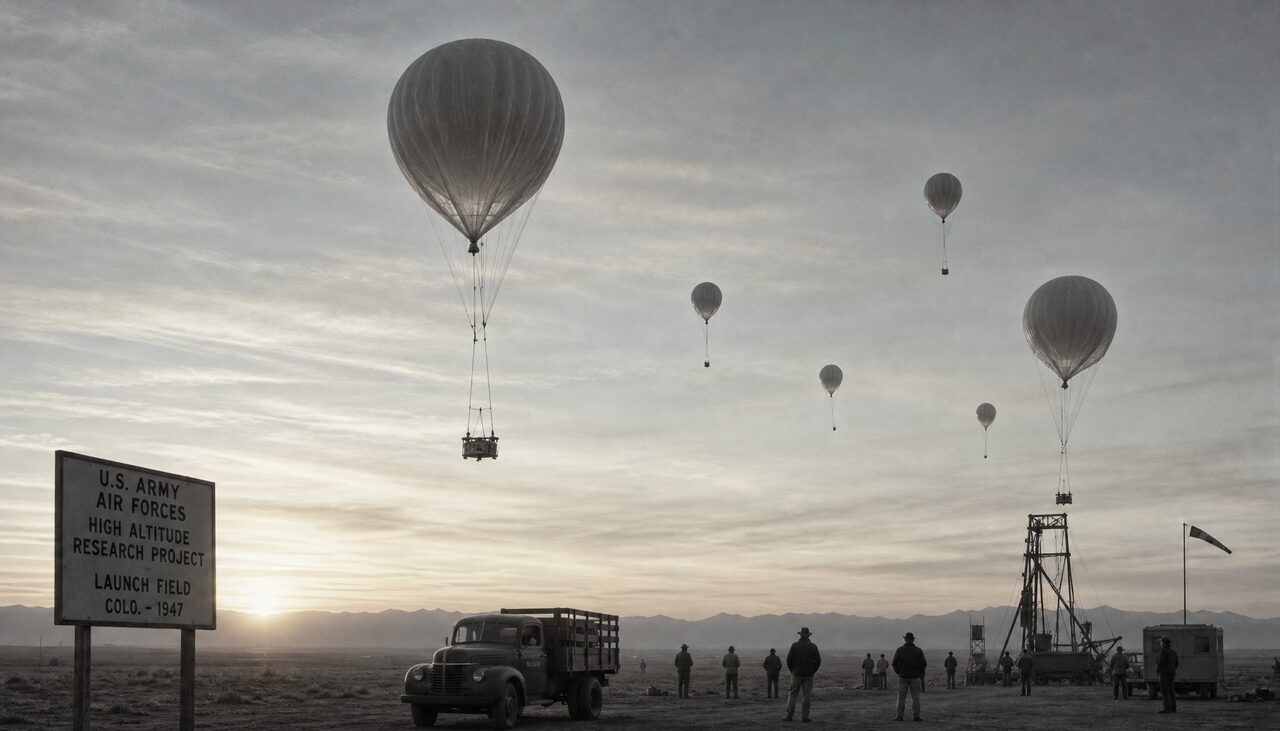
Mogul had a simple, paranoid purpose. The United States wanted to know the moment the Soviet Union tested its first atomic bomb, so it sent up long trains of high-altitude balloons carrying microphones to listen, from the upper atmosphere, for the sound of a distant explosion. The balloon trains were enormous — linked together, some ran hundreds of feet long, carrying radar reflectors made of foil, balsa, and tape. One of them, NYU Flight 4, launched in early June 1947, went up and was never recovered. It came down somewhere in the desert northwest of Roswell.
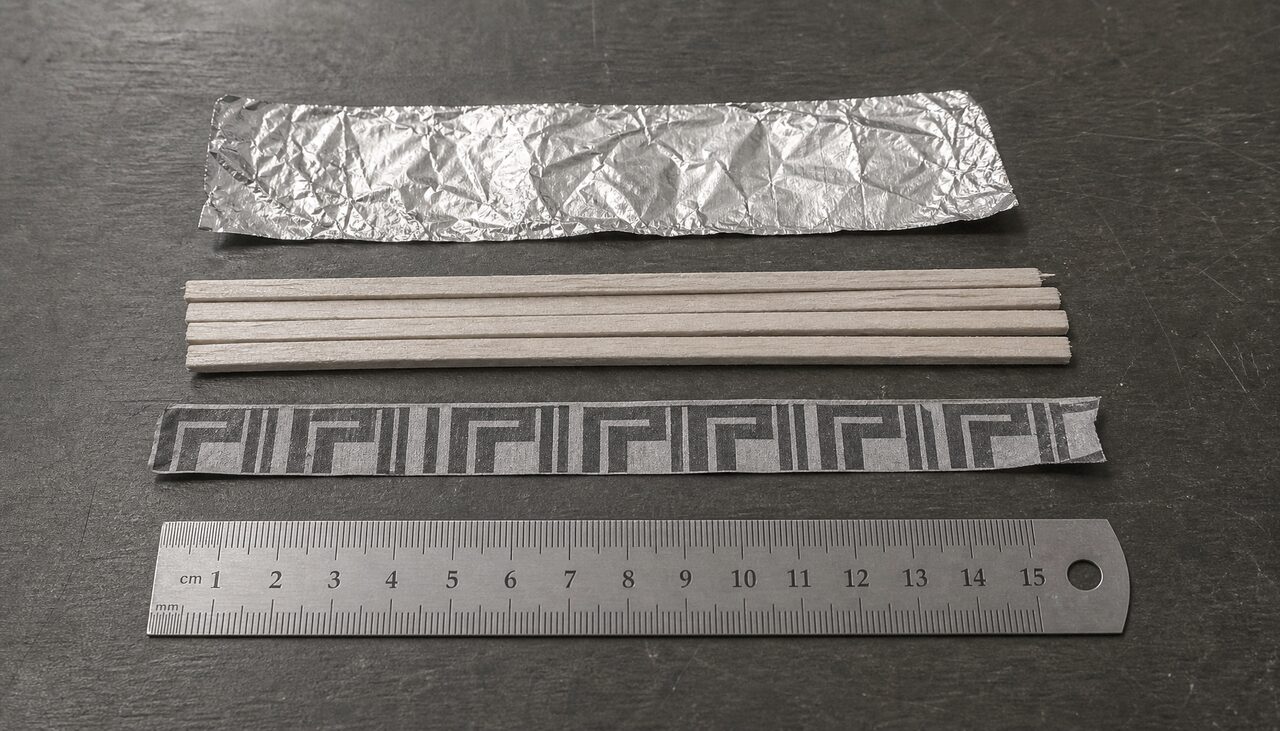
Foil. Balsa sticks. Tape with patterns printed along it. The debris in Brazel's pasture had not come from another world. It had come from the top of this one, listening for the end of it.
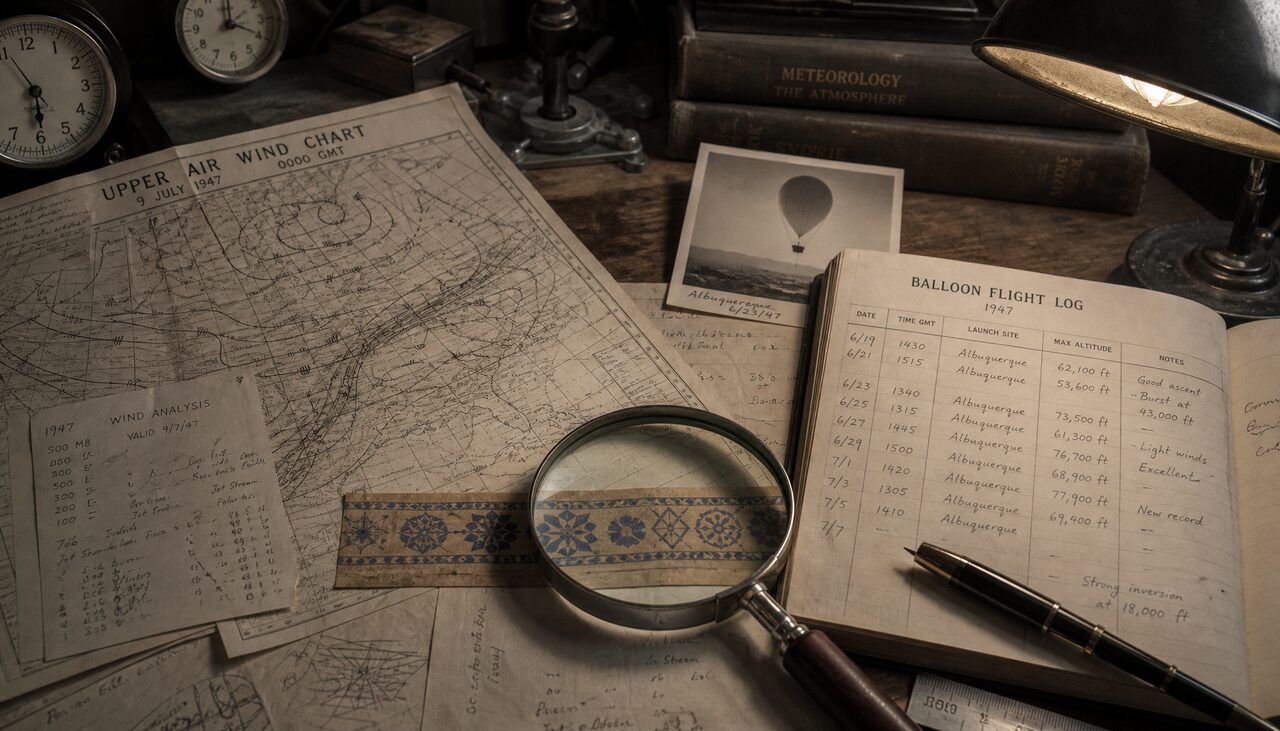
One of the Mogul scientists walked through it himself, decades later. Charles Moore had helped launch the balloon trains in 1947. He matched the lost flight to the recorded winds, and the winds carried it from the launch site toward the Foster ranch. Foil reflectors. Balsa struts. A reinforcing tape printed with small decorative figures. The alien hieroglyphics on the beams, it turned out, were flower-like designs from a novelty tape supplier.
The weather-balloon story finally made sense. It had not been a lie to cover a saucer. It had been a lie to cover a spy program. The Army hid a real secret behind a boring one, and the public, in the end, preferred a third option that was neither.
Case Closed?
That left the bodies. In 1997 the Air Force issued a second report, titled, with some confidence, The Roswell Report: Case Closed. Its explanation for the corpses was anthropomorphic test dummies. In the 1950s the Air Force had dropped human-shaped dummies from high-altitude balloons to test parachute systems, and recovery crews would arrive to collect them from the desert in nets and bags. To a distant witness, the report suggested, a man bagging a dummy and a man bagging a body look much the same.
It is not a crazy idea. Memory pulls bright objects from different years and builds them into one nest. But there was a problem with the dates, and the believers found it instantly: the dummy drops happened in the 1950s, and the crash was in 1947. The Air Force's final, definitive explanation for the bodies relied on props that would not exist for another six years. The cover story, once again, needed a cover story.
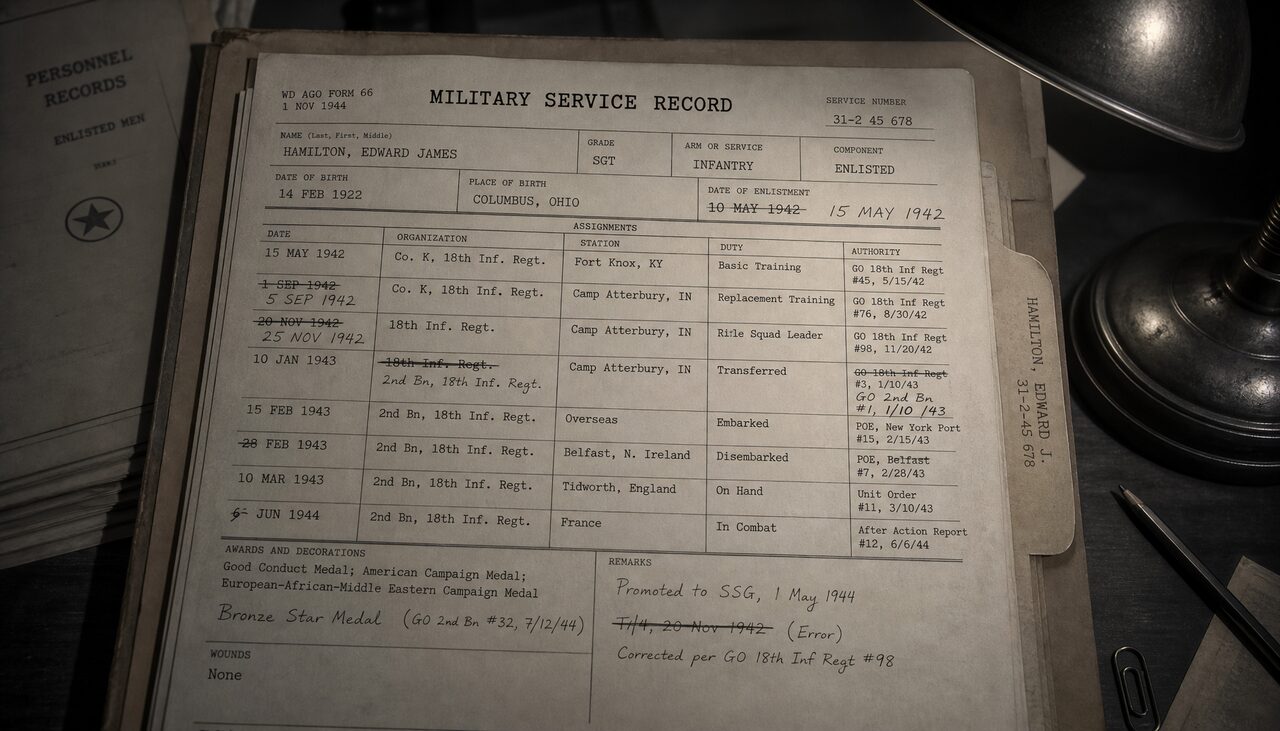
The key witness had his own problem. When researchers checked Major Marcel's account of himself, parts of it came apart. He had claimed a college degree, combat flying missions, and medals for shooting down aircraft, and the records did not support it. The man who remembered the metal had also, it seems, misremembered himself.
When the investigators looked, in 1995, they did find one genuinely odd thing. Many of the base's administrative records from the relevant stretch had been destroyed years earlier, with no explanation on file. To a believer, that is the sound of a shredder swallowing a saucer. To an archivist, it is a Tuesday — government offices destroy old paperwork constantly, badly, and without telling anyone. Both readings are true. Only one of them is interesting.
So here is where the evidence actually sits. A real spy balloon. Real foil. A real, clumsy cover-up. A central witness who embellished, and a set of bodies that no contemporary record contains. And a government that explained itself so many times it began to sound like it was hiding something, which is the one thing it is genuinely good at sounding like.
The Festival
Roswell could have stayed a dead story. It did the opposite. The town leaned all the way in. There is a UFO museum on Main Street, in a converted movie theater. The streetlights are shaped like alien heads.
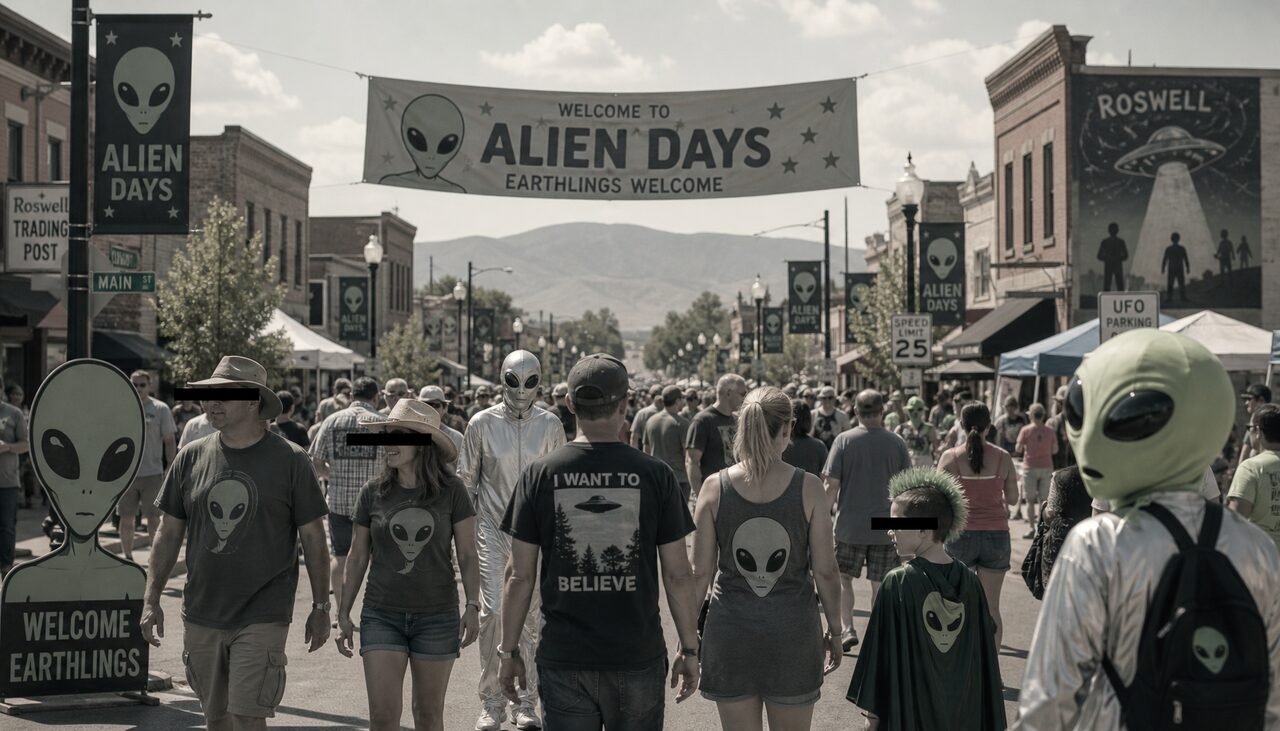
Every July, on the anniversary, the town holds a festival. Tens of thousands of people come for a parade, a costume contest, and an alien-themed five-kilometer run. A whole economy grew, self-sustaining, out of a press release the Army spent decades trying to take back. The Air Force got its facts onto the record twice — Project Mogul, Case Closed — footnoted, archived, and available to anyone who asks. It does not matter. The facts are at the National Archives. The crowds are in Roswell.
The numbers are not small. The festival pulls tens of thousands of visitors and millions of dollars into a town the interstate would otherwise forget. Roswell did the arithmetic the Air Force never could. An unsolved mystery is worth more than a solved one. A solved one closes.
The honest answer to Roswell is not a satisfying one, and that is the whole problem. A weather balloon is boring. A spy balloon is better. A spaceship is unbeatable. The evidence supports the boring one. The market supports the spaceship. And the market, here, has always set the price.
The available evidence suggests the thing in the pasture was a balloon, sent up to listen for the end of the world. What it unquestionably started was a parade.
Sources & Case References
- The Roswell Report: Fact Versus Fiction in the New Mexico Desert (U.S. Air Force, 1995)
- Encyclopaedia Britannica — "Roswell incident"
- Smithsonian Magazine — "The Real History of the Roswell UFO 'Cover-Up'"
- FBI Records: The Vault — "Roswell UFO"
- Charles Berlitz and William L. Moore, The Roswell Incident (1980)